

Canonical has been working with our testing lab partner, atsec information security, to prepare the cryptographic modules in Ubuntu 22.04 LTS (Jammy Jellyfish) for certification with NIST under the new FIPS 140-3 standard. The modules passed all of atsec’s algorithm validation tests and are in the queue awaiting NIST’s approval. We can’t

It’s a wrap – Canonical AI Roadshow 2023 has come to an end. From Brazil to the United Arab Emirates, from Europe to the US, we’ve spent an amazing 10 weeks talking with people all over the world about how to innovate at speed with open source artificial intelligence (AI), and how to make enterprise

Charmed MongoDB primary mission is to simplify the MongoDB experience so it can be an operated database powerhouse.

Google Kubernetes Engine (GKE) traces its roots back to Google’s development of Borg in 2004, a Google internal system managing clusters and applications. In 2014, Google introduced Kubernetes, an open-source platform based on Borg’s principles, gaining rapid popularity for automating containerized application deployment. In 2015, Google
Canonical is proud to announce that we have joined the Sylva project of Linux Foundation Europe as a General Member. We aim to bring our open source infrastructure solutions to Sylva and contribute to the project’s goal of providing a platform to validate cloud-native telco functions. Sylva was created to accelerate the cloudification of

Here, there, everywhere – MicroCeph makes edge storage easy Data is everywhere, not just in large centralised data centres, but in smaller outposts, like retail outlets, remote or branch offices, filming locations and even cars. Use cases for edge storage include local processing, content collaboration that cannot take place with high net
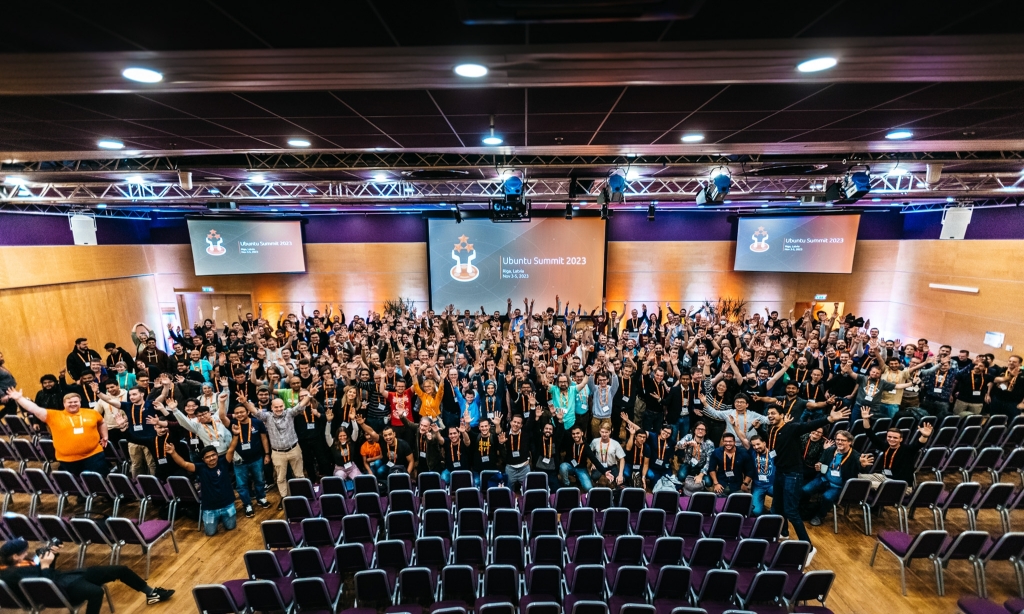
We have just returned from the stunning city of Riga, where Canonical hosted the Ubuntu Summit 2023, and we are still buzzing with the energy from meeting so many of you. Preparing this event was a team effort. A small team of us have been meeting for months, brainstorming ideas, preparing huge to-do lists, and

Part 1: The hardware setup As a first attempt at trying MAAS outside the lines (MOTL), let’s pick a random, inexpensive Next Unit of Computing (NUC). Indeed, let’s start with a Minis Forum N33, which is older and “out of print.” The relevant forum is offline, and manuals are hard to Google up. Nice challenge.

Newsletter signup

Intel and Canonical have been collaborating to deliver advanced infrastructure that can run the networks of the future. More and more, we see edge cloud systems deployed closer to end users and systems to meet the ever-increasing demand for faster edge networks that can rapidly deliver business services and boost productivity. This requir

It’s that exciting time of year, CES is almost here. With 2880+ exhibitors, the Consumer Electronics Show (CES) has cemented its position as the premier event for unveiling the latest technological advancements. With each passing year, CES becomes an even more integral platform for showcasing groundbreaking innovations. Join us at booth 9

Canonical is delighted to announce it is now a member of the RISC-V Software Ecosystem (RISE) to contribute to commercial readiness of open source software for RISC-V. Canonical’s commitment to RISE aligns with its broader mission to empower developers and businesses with open source solutions that enable them to build, deploy, and scale

When OpenAI released ChatGPT on November 30, 2022, no one could have anticipated that the following 6 months would usher in a dizzying transformation for human society with the arrival of a new generation of artificial intelligence. Since the emergence of deep learning in the early 2010s, artificial intelligence has entered its third wave

In the mission-critical workloads of modern enterprises, where time boundaries and determinism can make a major difference, the demand for real-time systems has never been more urgent. In our latest whitepaper, we delve into the realm of real-time Linux. The whitepaper is a comprehensive guide to understanding and unlocking the potential

Applying updates across a fleet of multiple Ubuntu instances is a balance of security and service uptime. We explore best practices to maximise stability.
In the last couple of years, the AI landscape has evolved from a researched-focused practice to a discipline delivering production-grade projects that are transforming operations across industries. Enterprises are growing their AI budgets, and are open to investing both in infrastructure and talent to accelerate their initiatives – so it’
Canonical, the publisher of Ubuntu, announced today the general availability of Charmed Kubeflow 1.8. Charmed Kubeflow is an open source, end-to-end MLOps platform that enables professionals to easily develop and deploy AI/ML models. It runs on any cloud, including hybrid cloud or multi-cloud scenarios. This latest release also offers the
Ubuntu tech blog
Deep dives for developers
Visit the Ubuntu Tech Blog for deep dives into product features, step-by-step tutorials, and the latest updates from Canonical's engineering teams.